Digg is back from the dead again as the once-iconic platform pivots toward an AI-driven news aggregation model.

The landscape of internet aggregation is defined by a cycle of disruption and obsolescence, and perhaps no brand exemplifies this volatility quite like Digg. After a turbulent year characterized by a failed pivot toward a community-driven Reddit competitor and a subsequent shutdown in March, the platform has emerged from its latest state of suspended animation. Kevin Rose, the original founder and current partner at True Ventures, has returned to the helm to spearhead a radical redesign that abandons the social forum model in favor of a sophisticated, data-heavy news intelligence engine.
A Chronology of the Modern Digg Reboot
The trajectory of Digg over the past eighteen months serves as a case study in the difficulty of reclaiming legacy digital territory. In early 2026, the company launched a high-profile effort to reclaim its status as a premier community forum, explicitly positioning itself as a challenger to Reddit. By June 2025, early previews of the platform suggested a focus on user-generated content and community moderation.
However, the reality of the 2026 digital ecosystem proved unforgiving. The revamped Digg struggled to distinguish its value proposition from the incumbent power of Reddit, and more critically, it faced an onslaught of automated bot traffic that compromised the integrity of its discussions. By March 2026, the company made the strategic decision to lay off staff and shutter the application to "retool" its core technology.
Following this hiatus, Rose assumed a full-time operational role in April. On the evening of May 8, 2026, he provided the first public glimpse of the new iteration via his social media channels. This version, currently accessible as a raw beta, signals a definitive departure from the "social forum" experiment and a return to the platform’s roots as a news aggregator—albeit one powered by artificial intelligence.
The New Engine: Algorithmic Curation Over Community Discussion
The fundamental shift in the new Digg is the transition from human-voted link sharing to machine-learned signal detection. The site currently focuses exclusively on the Artificial Intelligence sector, a strategic choice that leverages the high volume of real-time discourse surrounding the field.

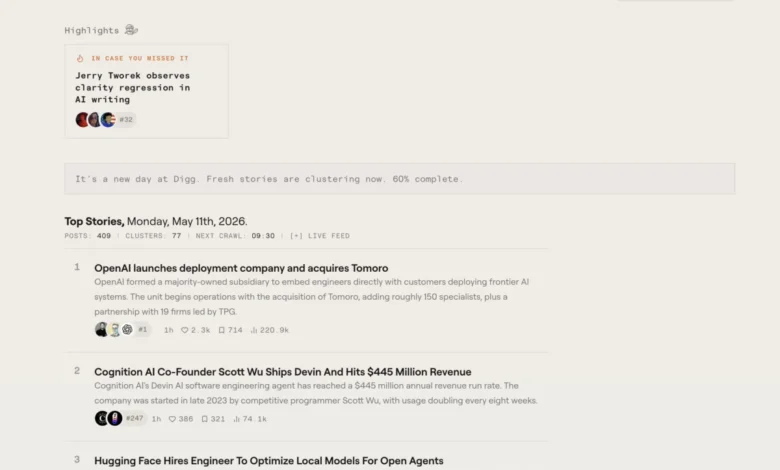
Rather than relying on user upvotes, the platform ingests data from X (formerly Twitter) in real-time. It employs a complex stack of sentiment analysis, content clustering, and signal detection algorithms to rank the relevance of news stories. The homepage is structured to surface four primary tiers of information: the most viewed story, a story undergoing a "rising discussion" trend, the fastest-climbing headline, and a "In case you missed it" selection.
Below this fold, the site provides a ranked list of stories, augmented by granular metrics such as view counts, comment volume, and save frequencies. Crucially, these metrics are not native to Digg; they are mirrors of the engagement occurring on external social platforms. As Rose noted in his commentary, the platform is designed to track the "velocity of influence." By monitoring high-profile accounts—such as those belonging to leaders like OpenAI’s Sam Altman—the system identifies emerging narratives before they reach mainstream saturation.
Data-Driven Insights and Market Positioning
The platform’s new value proposition is directed at a specific user segment: those who require a filter for the "noise" of the modern information cycle. By quantifying the impact of engagement, Digg provides a dashboard-like experience for users to track not just the news, but the people and organizations shaping it. The current interface features rankings for the top 1,000 individuals, companies, and political figures engaged in the AI debate, providing a leaderboard of influence that is rarely synthesized in such an accessible format.
However, the efficacy of this model remains under scrutiny. While data enthusiasts may appreciate the charts and sentiment analysis, the lack of native discussion on the platform presents a "read-only" experience that contrasts sharply with the conversational nature of modern social media. The company has acknowledged that the product remains in a "buggy" beta phase, intended for testing its signal-processing capabilities rather than facilitating a broad public launch.
The Challenge of Horizontal Expansion
A significant hurdle for Digg will be scaling this model beyond the niche of AI news. The current success of the platform relies on the fact that the discourse surrounding AI is highly concentrated on X. As the digital landscape has fractured, other topics have migrated to fragmented ecosystems, including Meta’s Threads, Bluesky, and private Discord servers.
The decline of the "global town square" poses a structural risk to an aggregator that depends on a single stream of social data to determine what is "important." If Digg cannot successfully ingest and correlate data from a broader array of decentralized sources, its signal-detection capabilities may become siloed, limiting its relevance to a subset of the tech-savvy audience.

Broader Implications for the Publishing Ecosystem
Despite these challenges, there is a potential silver lining for the struggling digital publishing industry. For years, independent publishers have faced a steady decline in traffic, accelerated by the rise of AI Overviews and the shifting algorithms of major search engines. These AI-driven summaries often strip away the necessity for users to visit the source website, thereby depriving publishers of the clicks and ad revenue required to sustain operations.
If Digg’s new iteration succeeds in driving traffic back to primary sources—by effectively curating and highlighting high-signal journalism—it could emerge as a critical traffic driver for news organizations. By positioning itself as a discovery layer rather than a content-replacement tool, Digg may align its interests with those of the broader publishing ecosystem.
Official Stance and Future Outlook
In communications to its beta cohort, the company stated that its ultimate goal is to "track the most influential voices in a space" and filter out the ambient noise that characterizes modern information consumption. While the company has not yet provided a firm timeline for a full public rollout, the internal messaging emphasizes a cautious, iterative approach.
The return of Digg is, at its core, an admission that the platform lost its way by trying to mirror the social dynamics of its competitors. By embracing its identity as a curator and a filter, the platform is attempting to solve a problem that has grown exponentially since the original site first debuted: the paradox of too much information. Whether an automated, AI-centric approach can capture the same cultural zeitgeist that defined the original Digg remains to be seen. In an era where trust and relevance are in short supply, the success of this iteration will depend not on the volume of its data, but on the perceived quality of its signal.
For now, the platform serves as a specialized utility for those tracking the rapidly evolving field of AI. Whether it can evolve into a general-purpose news aggregator for a fractured digital age will be the definitive test of Kevin Rose’s third—and perhaps final—attempt to keep the Digg brand relevant in the 2020s.